Aditya Birla Pivot / 2024
Aditya Birla Pivot Edge
An internal sales platform that generated ₹700+ crore in enquiries within one quarter of launch.
Web app · Internal tooling
Aditya Birla Pivot Edge
An internal sales platform that generated ₹700+ crore in enquiries within one quarter of launch.
Client
Aditya Birla Pivot
Role
Lead Product Designer
Timeline
8 months · 2024
Platform
Web app · Internal tooling
Context
Aditya Birla Pivot’s sales teams were stitching pipeline data together across four systems and a forest of spreadsheets. Pivot Edge brought the full enquiry journey into one focused workspace—helping regional managers and category managers run internal sales operations with greater speed, clarity and ease.
The team was losing hours every day to data reconciliation instead of selling. Regional managers lacked a clear view of enquiry progress, while category managers had to reconstruct pricing and negotiation context across disconnected channels. The brief was to simplify this handoff and make every enquiry easier to create, assign and advance.
Research approach
Understanding the people and workflow behind the brief.
Methods
- Contextual shadowing
- Diary studies
- Jobs-to-be-done interviews
- Usability testing
Participants
7 sales reps · 3 regional managers · 2 ops leads
Duration
6 weeks discovery + weekly validation cycles
Research storyboard

A day on the floor
Shadowed reps from first enquiry to end-of-day handover, timing every context switch.

What breaks trust
Interviews surfaced the habit of re-checking CRM fields by hand before every call.

One deal state
Mapped the deal lifecycle with engineering so screens and data told the same story.

Weekly think-alouds
Each module was tested live; anything that needed explaining got redesigned.
Illustrative scenes, not photographs from the original research.
Proposed follow-up survey
A framework for future validation, not reported survey findings: ask about workflow frequency, confidence in the information, the most difficult step, and what would make the task easier.
What emerged
Finding 01
Data trust is broken
Reps double-check every CRM field manually. If the workspace can't be trusted, it will be worked around.
Finding 02
Managers scan, reps focus
Two mental models in one product — glance vs deep-dive — needed distinct surfaces.
Finding 03
Next-best-action beats dashboards
Reps wanted a queue, not analytics. We turned insights into recommended moves.
Defining the problem
Problem statement
How might Aditya Birla Pivot help regional and category managers create, assign, and advance an enquiry without rebuilding its context across disconnected tools?
Working hypothesis
If we simplify the enquiry workflow from multiple steps to a streamlined flow, task completion time should decrease.
Design priorities
- Shadowed seven reps across three regions to map the real shape of a sales day.
- Co-designed a deal-state model with engineering so the UI mirrored a single source of truth.
- Built a token-driven component library that scaled to 40+ screens without redesign churn.
- Validated each module with weekly think-alouds — every flow earned its place.
From research to design
Ride along with the RMs
Two weeks shadowing relationship managers across three regions, timing every switch between CRM, WhatsApp and spreadsheets.
Contextual inquiry · Day-in-the-life timelines · Tool-switch audit
Name the real bottleneck
Mapped the enquiry-to-order journey and found the delay wasn't decision-making — it was waiting on data that lived in someone else's inbox.
Journey map · Pain-point matrix · Problem statement
One thread per enquiry
Modelled a single deal-state object with engineering so every screen reads the same truth, then wrote the IA around that thread.
State model · Information architecture · Content priority
Sketch the worklist
Low-fidelity flows for queue, share and error states — tested on paper with RMs before a single component was styled.
Crazy 8s · Flow diagrams · Paper prototypes
Weekly think-alouds
Clickable prototypes tested every Friday; the share module alone went through four rounds before the margin field earned its place.
Usability testing · Task success metrics · Iteration log
Low-fidelity exploration · schematic reconstruction
Structure before visual design
These simplified layouts illustrate the information hierarchy and task sequence; they are not original research artifacts.
Testing & evidence
Improve sales-team productivity by making enquiry creation faster, clearer and less error-prone.
Measures considered
Completion time · Task success · Steps · Errors · Adoption
| Measure | Before | After |
|---|---|---|
| Enquiry completion time | 12 min | 8 min |
| Steps | 7 | 4 |
| Task success | 72% | 91% |
I actively identify, document and validate assumptions to minimise bias. Decisions are based on observed evidence and measurable outcomes—not untested certainty.
Outcome
The redesign was validated through usability testing and stakeholder and user feedback. After launch, Aditya Birla Pivot recorded ₹700+ crore in enquiries in a single quarter, while the shared workflow made day-to-day sales operations easier for regional and category managers.
The final interface
A closer look at the product screens and the decisions they support.
01
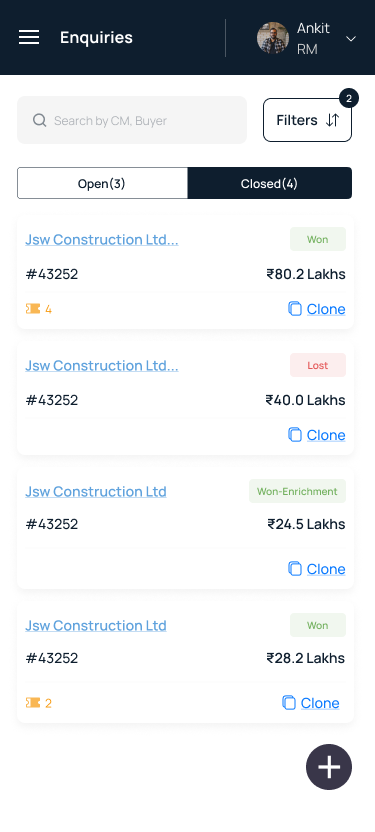
The pipeline, at a glance.
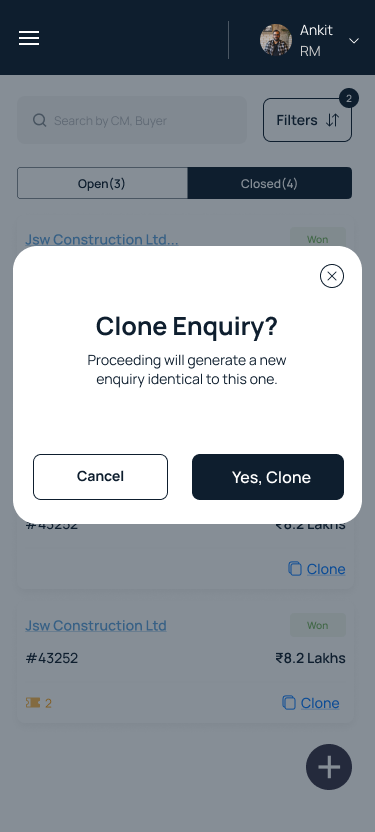
Open and closed enquiries live in one list, each card carrying the buyer, the enquiry ID, the value and the outcome. Repeat business is the norm in steel, so cloning a won enquiry is a first-class action — not a copy-paste ritual across three tools.
02
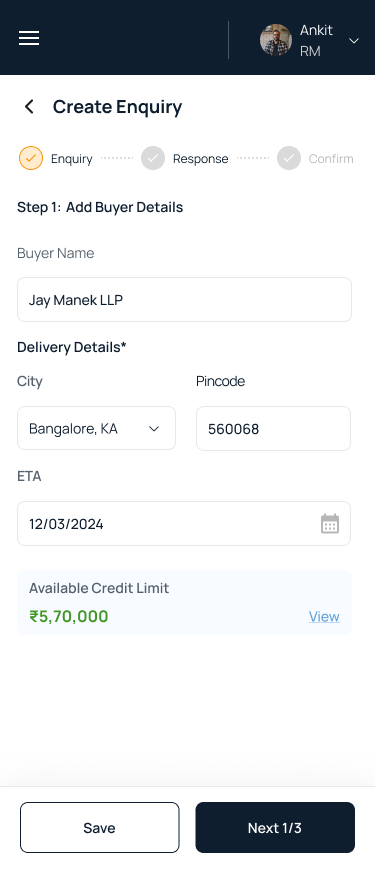
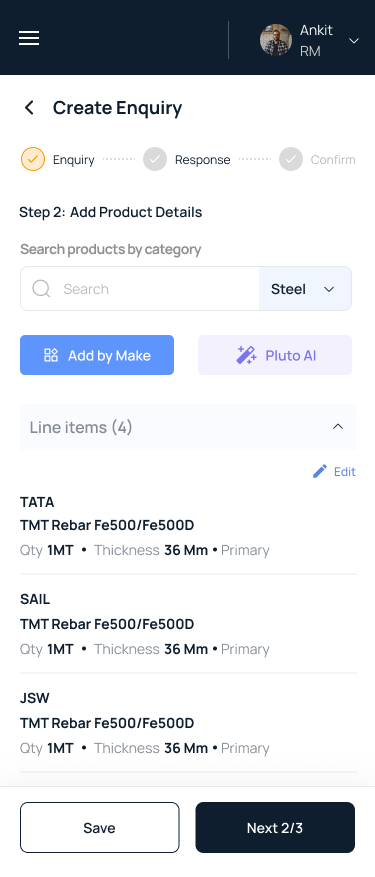
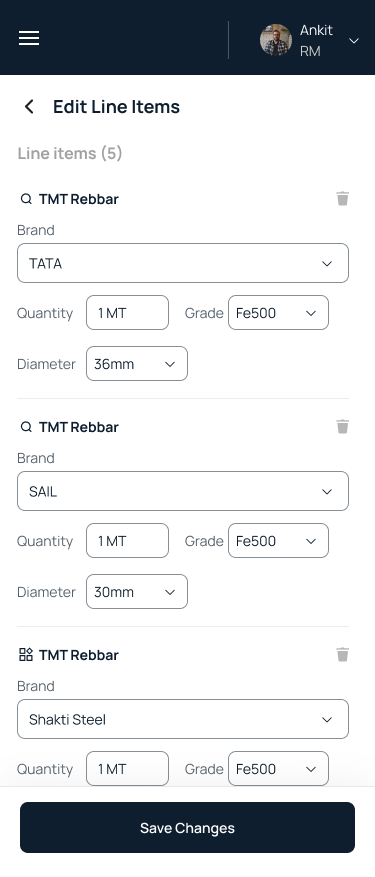
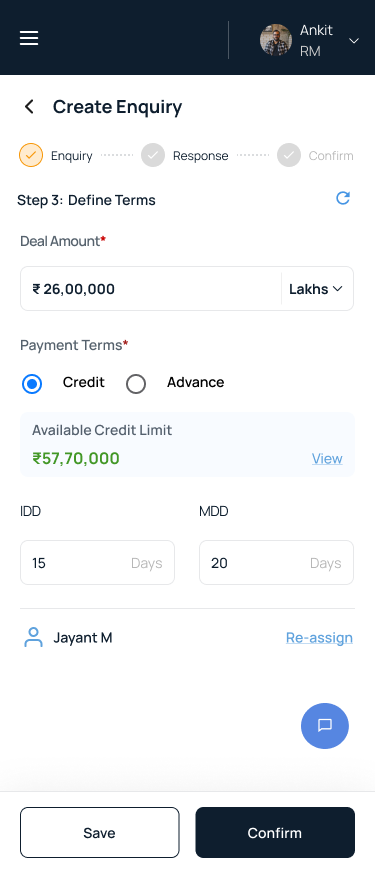
Three steps to a live enquiry.
Creating an enquiry used to mean a spreadsheet, a credit check over the phone and a WhatsApp thread. The flow compresses it into three signposted steps — buyer, products, terms — with credit limit surfaced at every point where it changes a decision.
03
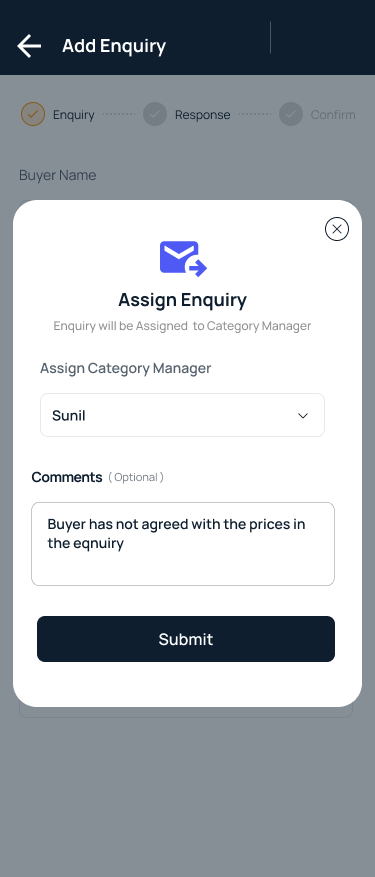
The handoff.
A regional manager cannot price alone. Assignment is modelled as an explicit, reversible handoff to a category manager—with the negotiating context attached—so both roles can move an Aditya Birla Pivot enquiry forward without rebuilding the story.
04
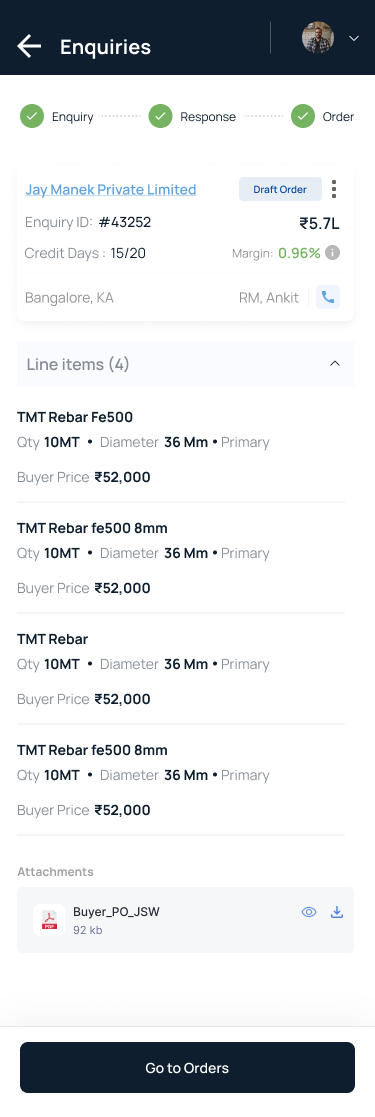
The queue.
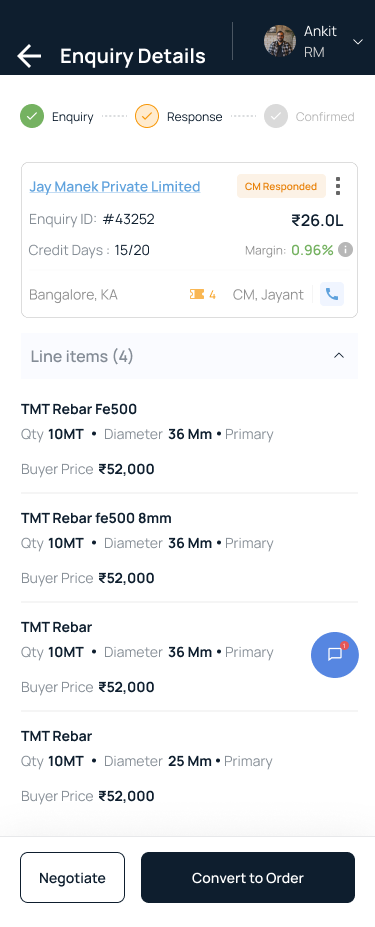
Regional and category managers open to a shared worklist—every enquiry stamped with its stage, margin and current owner. This simplified Aditya Birla Pivot’s internal sales operation by making the next action visible without another spreadsheet, call or screen.
05
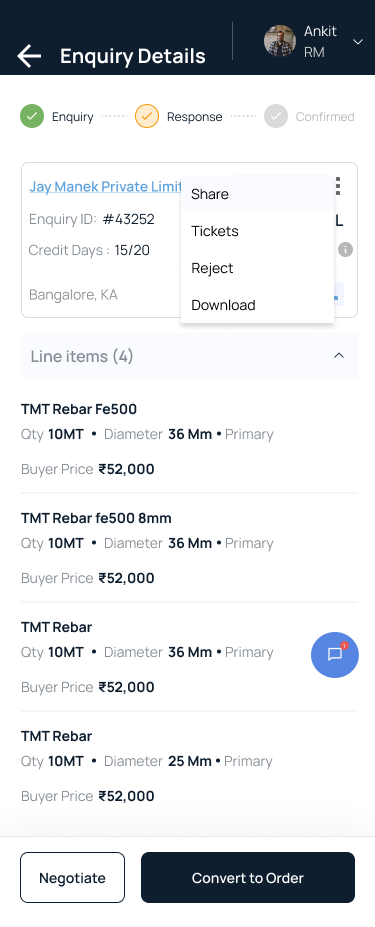
The exchange.
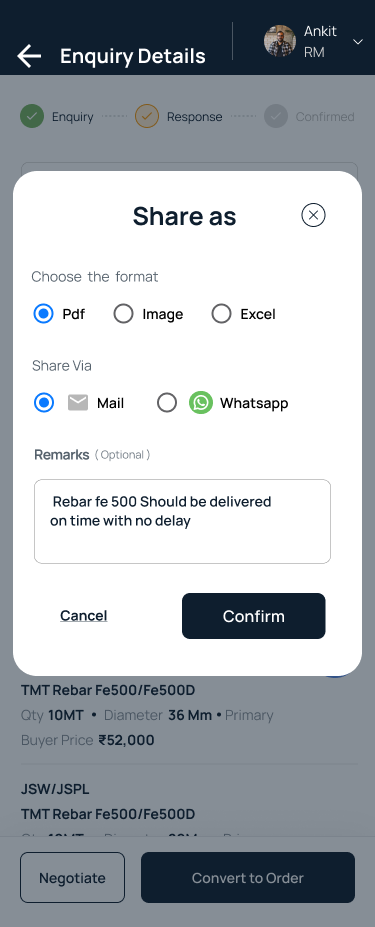
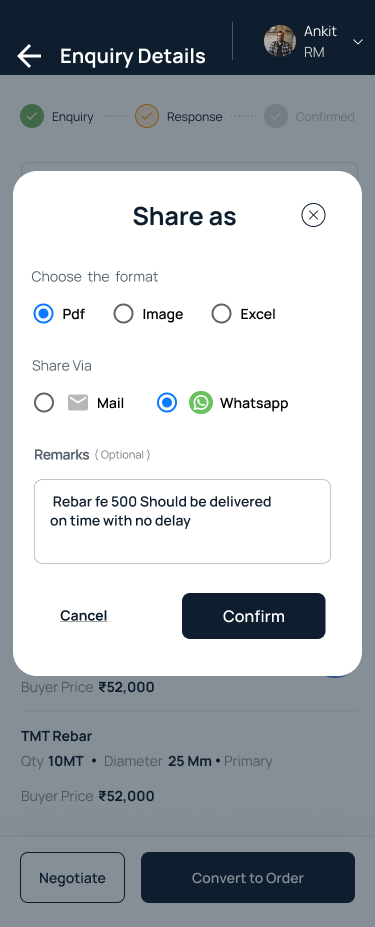
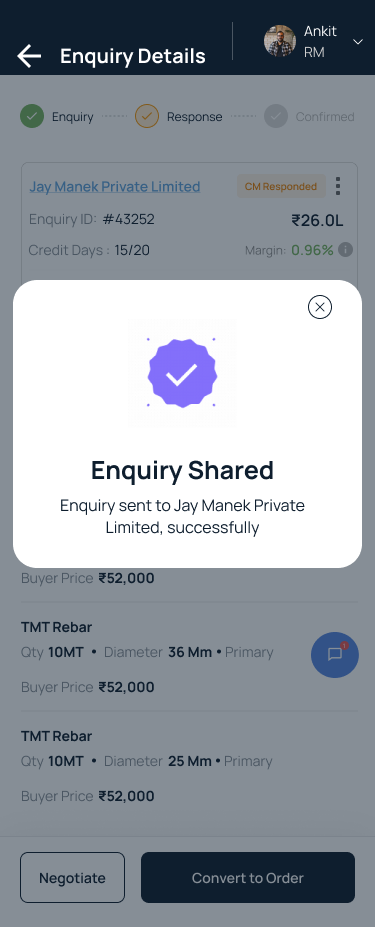
Buyer POs still travel as PDFs and WhatsApp messages. Instead of fighting that, Pivot Edge builds it in — export as PDF, image, or Excel, send it wherever the buyer actually reads it, and thread the back-and-forth alongside.
—
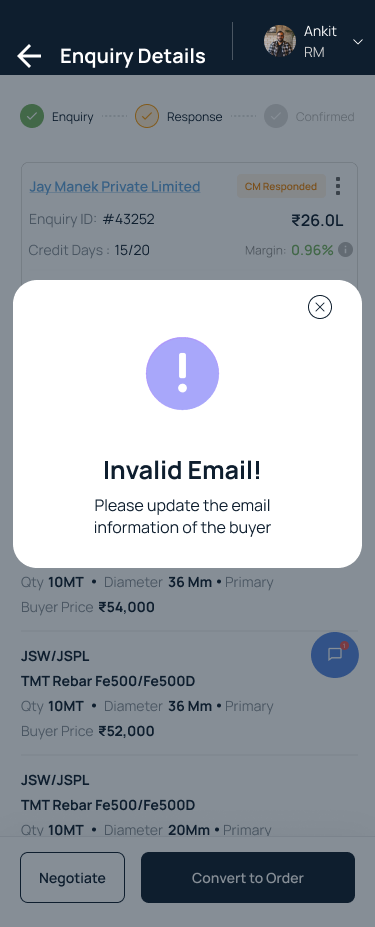
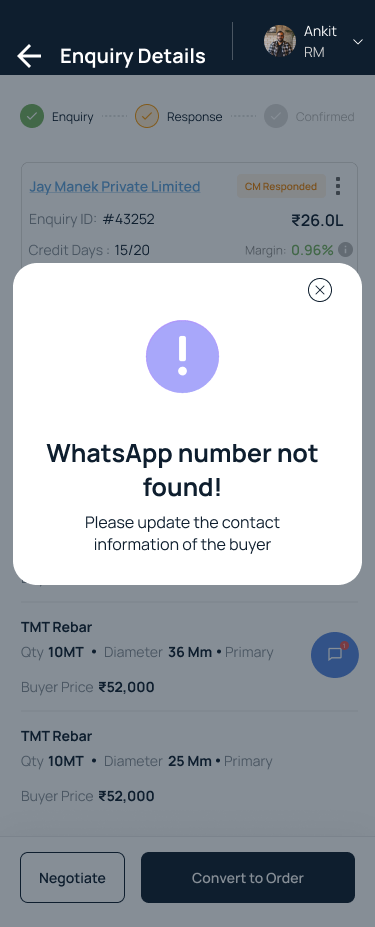
When the data isn't ready.
Missing contact details fail a share every time. Rather than a generic error, the module names the exact field and points back to the fix.